* denotes equal contribution. Full list on Google Scholar.

Filter by topic Showing all 11 papers
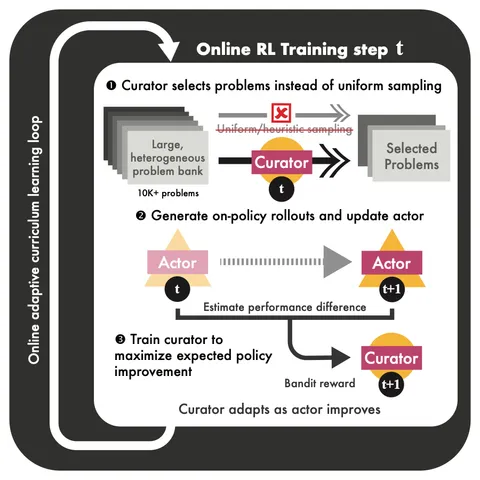
Figure from Actor-Curator: Co-adaptive Curriculum Learning via Policy-Improvement Bandits for RL Post-Training
Zhengyao Gu*, Jonathan Light*, Raul Astudillo, Ziyu Ye, Langzhou He, Henry Peng Zou, Wei Cheng, Santiago Paternain, Philip S. Yu, Yisong Yue

A scalable, fully automated curriculum-learning framework for RL post-training of LLMs. Learns a neural curator that selects training problems to directly maximize expected policy improvement, formulated as a non-stationary bandit with regret guarantees. Delivers +28.6% on AIME2024, +30.5% on ARC-1D, and up to 80% speedup over the strongest baseline. Outstanding Paper Award and Oral (top 3.9% of accepted papers) at the ICLR 2026 Logical Reasoning Workshop.
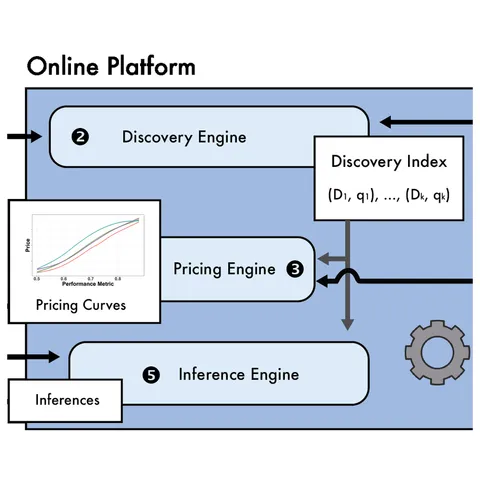
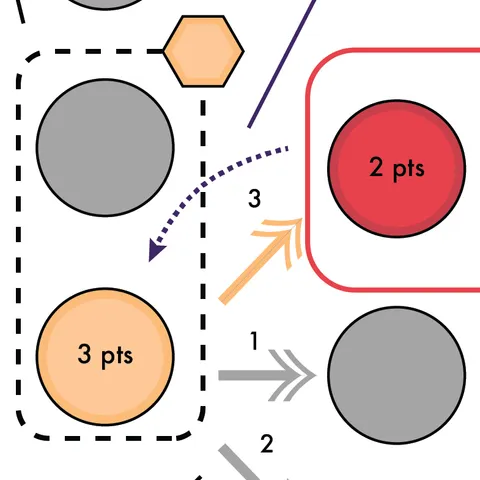
Figure from A Data-Centric Online Market for Machine Learning: From Discovery to Pricing
Sainyam Galhotra*, Minbiao Han*, Jonathan Light*, Steven Xia*, Raul Castro Fernandez, Haifeng Xu

A data-augmented AutoML market that automatically augments a buyer's training data with external datasets and prices the resulting model by its measured performance gain rather than compute. Pricing is grounded in the instrumental value of the sourced data, which sidesteps direct dataset pricing, mitigates strategic buyer behavior, and accommodates diverse valuations through menu-based options.

Hongliang Chi, Qiong Wu, Zhengyi Zhou, Jonathan Light, Emily Dodwell, Yao Ma

Frames data selection as a sequential decision-making problem, with data values acting as encodings of the optimal selection order. Shows that methods like Data Shapley are myopic linear approximations of this problem, explains when they fail as utility curvature increases, and introduces a bipartite graph-based surrogate for scalable greedy selection with provable guarantees, evaluated on classical ML benchmarks and large-scale LLM fine-tuning data selection.

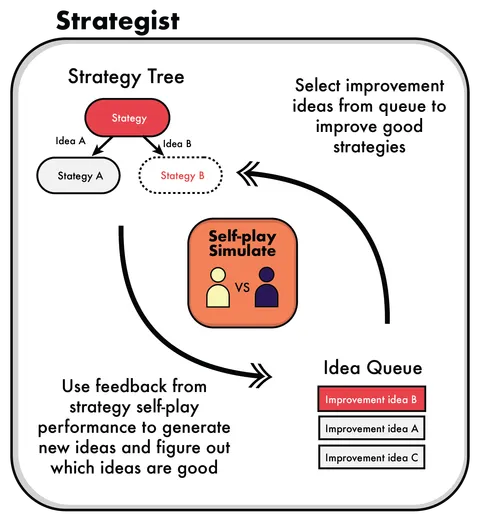
Figure from Strategist: Self-improvement of LLM Decision Making via Bi-Level Tree Search
Jonathan Light, Min Cai, Weiqin Chen, Guanzhi Wang, Xiusi Chen, Wei Cheng, Yisong Yue, Ziniu Hu

LLM + MCTS hybrid that learns to optimize its own decision process through self-play and strategy refinement. Outperforms RL and existing LLM agents, achieves human-level performance in complex games. Highlighted in the State of AI Report 2024 as a breakthrough in autonomous agent design.

Figure from Shockingly Simple Self-retrospection Improves Agentic Models Without RL
Jonathan Light, Christopher Zhang Cui, Jeonghye Kim, Roger Creus Castanyer, Emiliano Penaloza, Zhengyan Shi, Alessandro Sordoni, Marc-Alexandre Côté, Xingdi Yuan, Minseon Kim

Introduces Retrospection-Only Fine-Tuning (ROFT): an agent attempts a task, writes a retrospective explanation, and is fine-tuned on that explanation alone - no verifier or reward-based update. With Qwen3.5-4B, reaches 49.2% on SWE-bench Verified and 26.8% on SWE-bench Pro after 20 updates, beating GRPO after 40 updates.

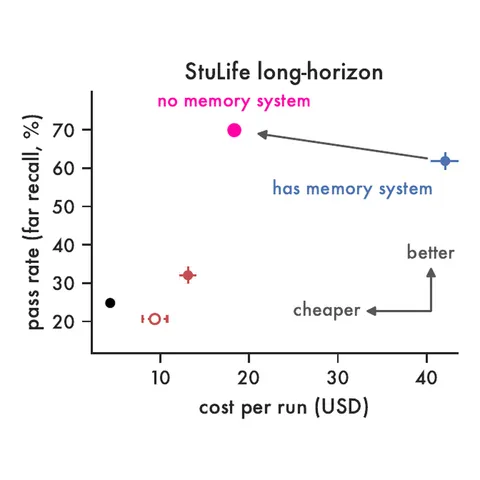
Figure from Harness as a Language: A Minimalist Agent Framework With Maximal Expressivity
Zhening Li, Joshua Liu*, Mateja Vukelic*, Nicole Shen, Supriya Lall, Amitayush Thakur, Alex Zhang, Omar Khattab, Jonathan Light, Armando Solar-Lezama

Introduces JAZ, a minimal LLM agent framework built on a single language primitive, invoke: a function whose body is written by the LLM at call time, with recursive calls and the full interaction history available as variables in a Python REPL. With prompting alone and no dedicated memory or meta-harness, JAZ beats Letta (MemGPT) by 8% at half the cost on long-horizon StuLife recall and beats ACE by 4% at lower cost on AppWorld self-improvement. Oral (top 2% of submissions) at the NeurIPS 2026 Meta-Agents Workshop.

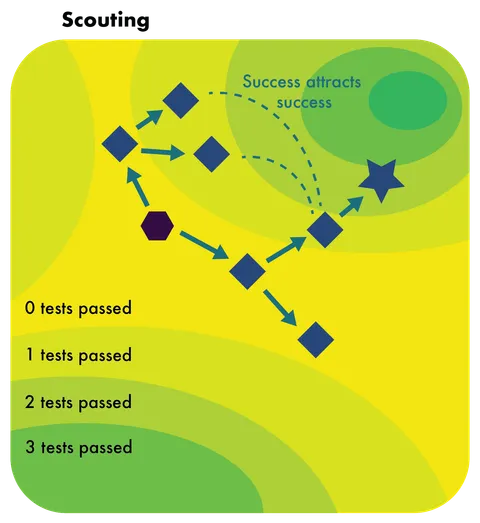
Figure from Scattered Forest Search: Smarter Code Space Exploration with LLMs
Jonathan Light, Yue Wu, Yiyou Sun, Wenchao Yu, Yanchi Liu, Xujiang Zhao, Ziniu Hu, Haifeng Chen, Wei Cheng

Reframes code generation as black-box optimization: uses Scattering, Foresting, and Scouting to boost exploration + feedback exploitation. Achieves SOTA on HumanEval, MBPP, APPS, CodeContests, LeetCode (e.g. 87.2% pass@1 on HumanEval) while halving iterations vs prior methods.